


It is a medieval hamlet with a great artistic and landscape charm, rich in history and legends, with a castle dedicated to Venus. Erice exerts a particular fascination when thick fog covers it. It is directly linked to Trapani by cableway, easily accessible to everyone and from which a breathtaking view, ranging from the east to the west, can be admired...
Situated in the eastern tip of the Gulf of Bonagia, Custonaci stands on a hill at about 200 meters above sea level, just behind the Bay of Cornino. It borders with the famous municipalities of Valderice, San Vito Lo Capo and Castellammare del Golfo.
Custonaci is an integral part of the area called “Agro-Ericino (countryside around Erice)” and it has developed its full potential on marble quarrying, especially the "Perlato di Sicilia" (a light ivory-coloured marble), so that today Custonaci is the second most important marble quarrying area in Italy. There are many quarries currently in operation, which contribute to make the surrounding landscape really suggestive.
The “Caves of Scurati” are located in its territory; within them some archaeological finds have been discovered, thus confirming that the area has been inhabited since the Upper Paleolithic. For some years, in the Christmas period, the "Living Crib of Custonaci” has been taking place, which attracts many tourists and believers.
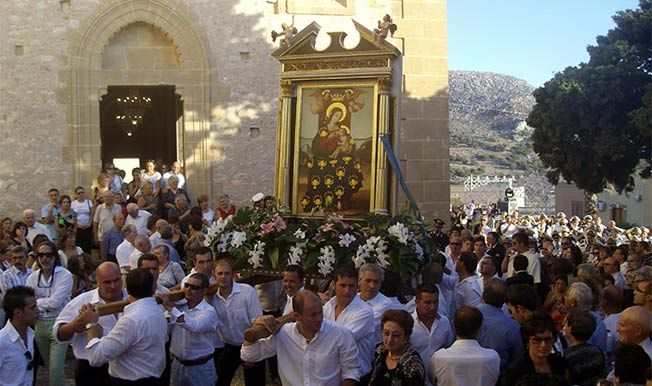
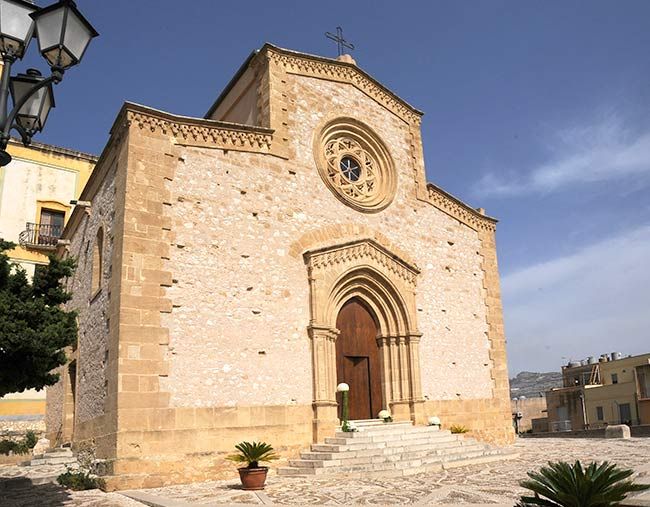
A place of historical and artistic interest is the shrine of “Maria Santissima (Most Holy Mary) of Custonaci”, where an oil painting dating back to the 15th century is kept. It depicts the Virgin breast-feeding the Child and attributable to the school of Antonello da Messina,. The painting is object of great devotion for the inhabitants of Custonaci and the surrounding municipalities.
The last week of August the feast in Her honour is held: a procession by sea makes it really evocative and unique. A multitude of boats (some boatmen allow visitors to assist the procession by their boats, so that they can live it closely) accompany the painting until the landing, in the beautiful setting of the Bay of Cornino. The Holy Image is placed on a wagon and carried on the shoulders of faithfuls up to the Shrine, accompanied by the local band and fireworks. The entrance in the shrine is the most evocative moment, among prayers and applauses.
Stella Maris (Our Lady, Star of the Sea)
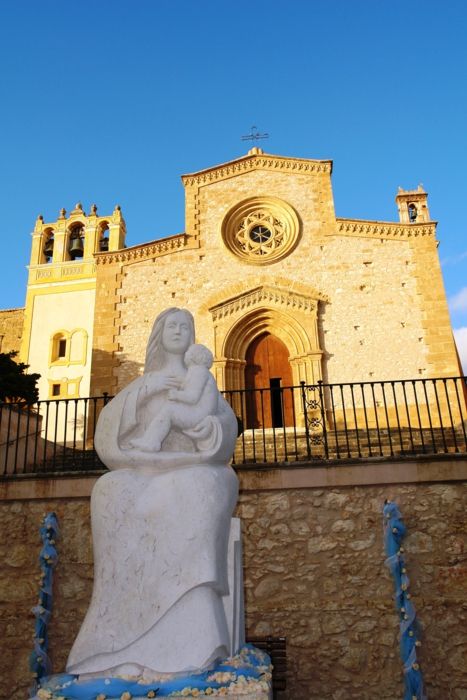
Stella Maris (Our Lady, Star of the Sea) is a tribute to Our Lady, in memory of all the vic-tims who lost their lives at sea in search of freedom.
In 2009 Custonaci, which has been devoted to the Virgin Mary for hundreds of years, was recognised as “Civitas Mariae” (the only city in Sicily to receive this prestigious recogni-tion, and one of the five cities in Italy). In the same year a group of devotees and sea en-thusiasts, with the aim of strengthening the cult of the Virgin Mary coming from the sea in order to protect seafarers, commissioned the local sculptor G. Cortese to build a statue.
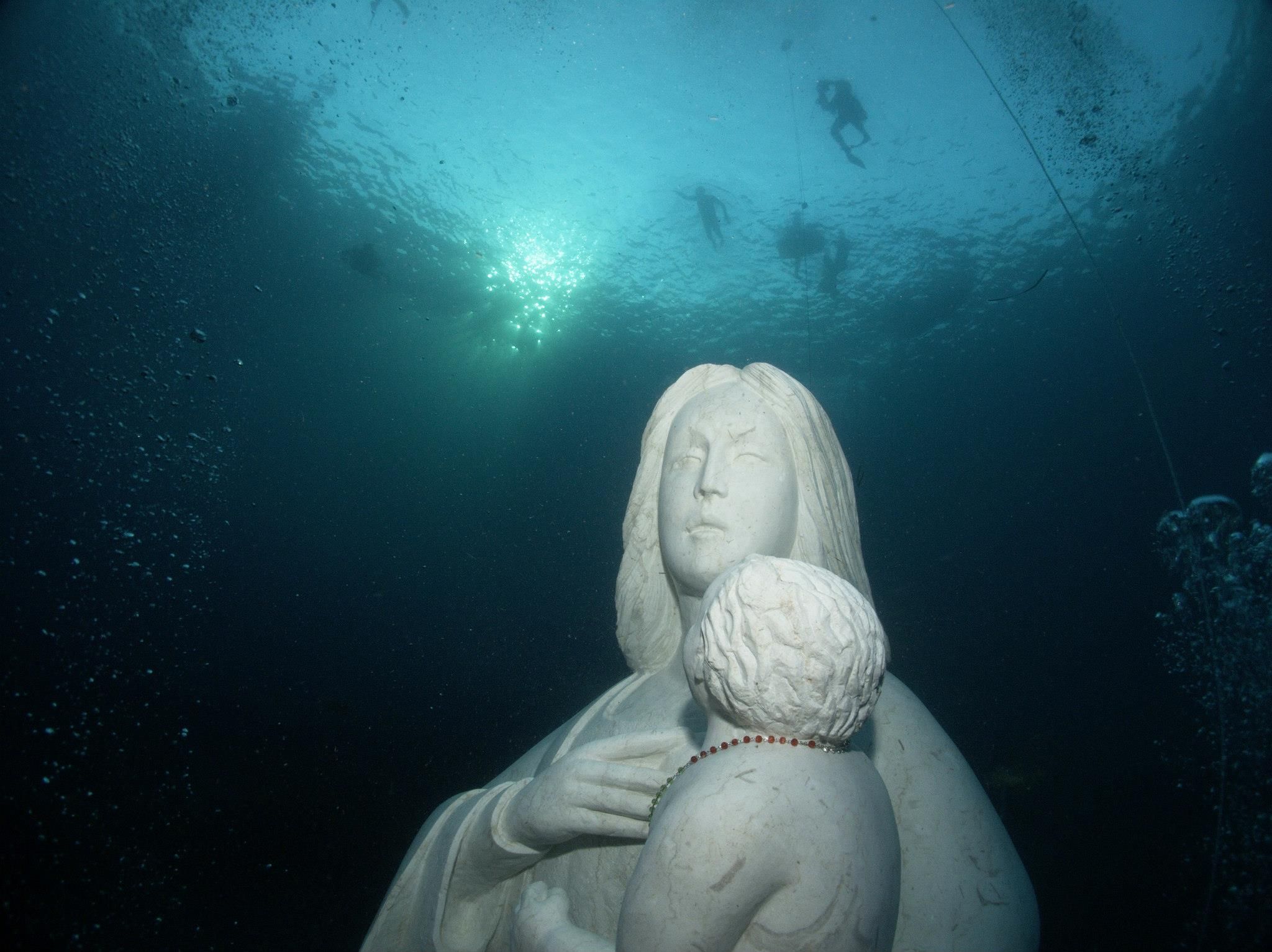
Carved from a single block of marble, the precious "Perlato di Sicilia” (light ivory- coloured and extracted from the quarries of Custonaci), the marble statue is 5 meters high and weighs about 11 tons. It looks towards the sea and is located at the depth of 13 meters, off the coast of Mount Cofano, in the enchanting bay of Cornino.
In 2012, before it was placed on the seabed, the statue was blessed by the Bishop of Tra-pani. The event, both religious and environmental, has aimed at rediscovering an old de-votion and at revealing the undersea beauties of this area.
So, the effigy of Our Lady of Custonaci, that according to local tradition came 5 centuries ago from the sea, is back to the sea.
Its exact location is indicated by a red buoy: with a diving mask is possible to admire its beauty and majesty. Here, in the exact point, many diving centers organise beautiful un-derwater excursions.
Custonaci confirms and renews its religious devotion with Stella Maris, by adding a fas-cinating place for believers and diving enthusiasts.
Altre localita

The isle of Mothia offers an opportunity for a walk amid the wonders of its vegetation and archaeology. The isle, of Phoenician origins, can be exclusively visited on foot: it is the largest among the islets off the coast of Marsala, and together form a lagoon with evocative colours.

Segesta is one of the most evocative archaeological sites in Sicily, with its stunning temple built on a hilltop, dating back to the period between 430 and 420 b.C. Its Doric Temple and Theater are of rare beauty...

Selinunte, an ancient Greek city on the south-western coast of Sicily (Castelvetrano), has got the largest archaeological park in Europe. Here the Doric style has found one of its finest expressions. It takes 2 to 6 hours to visit the Park and it is open all year round.

In ancient times it was called “Drepanon (Greek word that means “sickle”) for its shape. Trapani is also known as the city of salt and sailing and it is a perfect place for a holiday combining art, sea, nature and food and wine.

The Procession of the Mysteries is one of the oldest and most important processions in Trapani. It starts on Good Friday at 2.00pm from the Church of the Purgatory going on for 24 hours through the streets of the city.

During this event, held in September, different ethnic groups are blended together to create couscous dishes with various colours and flavours. Cous Cous Fest is the International Festival of Cultural Integration, an important event recurring from past 25 years...

Its crystal-clear waters offer tourists a unique spectacle. Snorkeling is the best way to enjoy this beautiful deep blue sea.

Favignana, Levanzo, Marettimo with different characteristics and remarkable beauties, rise majestically above the sea off the coast of Trapani...

It can be easily reached by going along most of the northern coast of Trapani and it welcomes tourists already delighted by splendid views accompanying them along the way...

Zingaro Nature Reserve is located in the western part of the Gulf of Castellammare, near San Vito Lo Capo. It is an area rich in vegetation and it is one of the few stretches of coast in Sicily without a coastal road...

The picturesque sea village of Scopello and the Zingaro Nature Reserve are the most charming places of the gulf of Castellammare.

Grazie al suo grande interesse naturalistico, speleologico, paesaggistico e storico, la Riserva Naturale del Monte Cofano regala al turista l’habitat ideale per una vacanza dal gusto intenso...

The Reserve extends itself between the municipalities of Trapani and Paceco. At sunset, the sun reflecting on the salt marshes and the white colour of the salt gives the sky special colours that are worthy being immortalised by a camera...

It is located in the western part of the Gulf of Castellammare, in the San Vito lo Capo Peninsula overlooking the Tyrrhenian Sea, and it was the first Nature Reserve to be established in Sicily...

The Mangiapane Cave, located in the hamlet of Scurati in Custonaci, is a fascinating rural village nestled into the rock and inhabited for over 150 years. A unique place where history, traditions, and nature blend together, open to visitors all year round and famous for its evocative Living Nativity Scene that brings the cave to life during the Christmas season.

Built in 1595 to defend the coast from pirate raids, the San Giovanni Tower is an imposing stone sentinel nestled within the Monte Cofano Nature Reserve. Once a strategic bulwark of the Sicilian sighting system, it is now an unmissable historical landmark for hikers, offering a unique panorama where the mountain meets the sea of Custonaci.